Damien Hirst is a world famous English artist whose work I find extremely interesting. He was born in 1965 in Bristol. but grew up in Leeds and later on studied Fine art in Goldsmiths college. He first came into public attention in 1988, when he created and curated Freeze, an exhibition held in an abandoned warehouse in which his fellow Goldsmiths colleagues and him showed their work.
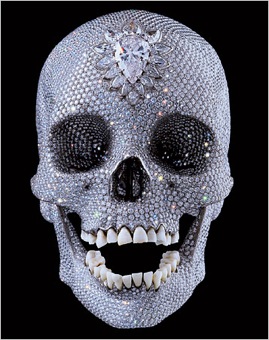 |
| Damien Hirst's $100 million diamond skull |
.
Hirst developed an interest in investigating the idea of death. From the early age of sixteen he would visit the anatomy lab of Leeds Medical School in order to make life drawings. In 1991 he started working in his most famous series so far, and my personal favorite, 'Natural History'. He had dead animals put in minimalist steel and glass tanks and preserved in formaldehyde - sometimes having been dissected first. His first ‘Natural History’ works were a pair of fish cabinets, created whilst studying, called ‘Isolated Elements Swimming in the Same Direction for the Purpose of Understanding’. Shortly after that ‘The Lovers’, ‘Anaesthetics (and the Way they Affect the Mind and Body)’, 'Stimulants (and the Way they Affect the Mind and Body)' and the renowned shark piece, ‘The Physical Impossibility of Death in the Mind of Someone Living’ followed.
 |
| Physical Impossibility of Death in the Mind of Someone Living (1991) |
Since 1991,Damien Hirst has included animals variously divided, crucified, skinned and in positions of prayer to the series. In 2006, Hirst exhibited a triptych titled ‘The Tranquility of Solitude (for George Dyer)’ , which incorporated three flayed sheep carcasses in a remake of Francis Bacon’s ‘Triptych May–June 1973’.
Personally, as a photography student, I find his work very influential and overall fascinating. The fact that his work is so morbid, yet so beautiful, makes you question the concept of death and the sadness that comes with it.

No comments:
Post a Comment